Post Media/National Post
•
10th April 2026
How did a Canadian reporter end up living in rural Wales?
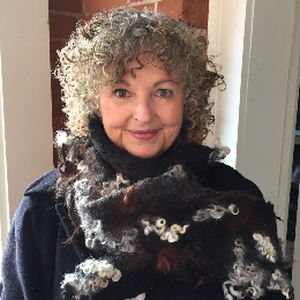
Toronto-born journalist Nancy Durham spent decades reporting from international conflict zones, from the Balkans to Iraq.
Consider what the opposite of that job might be. How about becoming a self-taught lavender farmer on what Durham calls a “wild, windswept Welsh hilltop?”
Durham didn’t see starting the first commercial-scale lavender farm in Wales as an antidote to the misery and turmoil she’d reported on for years. Yet, that’s how it turned out.
“It was just such a contrast from all the unhappiness in the world to create the farm,” said Durham, 73, via a video link from her cozy cottage kitchen. “But you know, it was all accidental and it’s rolled out beautifully because it gave me yet another career when I was least expecting it.”
How did a Canadian reporter end up living in rural Wales? Durham said in a 2025 profile that “love and adventure” brought her there more than 40 years ago.
She met Canadian-born Oxford philosopher of science Bill Newton-Smith in 1981 at a party in Toronto. That was the love part. Adventure kicked in a couple of years later when she moved to the UK in 1984 to be with him. Durham reported from global hotspots for various broadcast outlets, including the CBC and the BBC.
The couple divided their time between Durham’s London flat, the medieval university town of Oxford where Newton-Smith was teaching and the small farm cottage he owned in Wales near Bannau Brycheiniog National Park.
Durham said her first impression of the cottage was that she was walking into “a wreck.” She was smitten.
“No electricity and candle wax everywhere, melted on everything, because that was how it was lit,” she said. “It was very romantic and very rustic and rugged and gorgeous. And it still is.”
After they expanded the acreage surrounding the hilltop cottage in 2003, they considered raising sheep, the most common use for area farmland.
They went in a more fragrant direction instead. They planted about 3,000 Grosso lavender shrubs along the hillside that year and harvested the first crop the next summer.
The couple were also the first business in Wales to distill lavender oil, using it to make creams and balms for a new business that became Farmers’ Welsh Lavender. The aromatic and minty Gorsso lavender works well in Farmers’ products because it suits everyone, Durham said. “What we do is for men, women and anybody in between.”
When she compares her small yield to the millions of plants at a typical lavender producer in France, Durham affectionately calls Cefnperfedd Uchaf (Welsh for “tucked in behind the ridge) a dinky farm.
Small works for her. With spectacular views across steep green hills and the deep valley from the cottage’s perch 1,100 feet up, who needs a million lavender shrubs to tend?
They didn’t really know what they were doing when they began, said Durham. A $50 book on lavender farming from a Texas grower got them started. The still they bought to extract the lavender oil came with instructions. Presto, says Durham, she could add running a still to her resumé.
“Distilling is an elegant, simple and beautiful process. I did all the distilling initially and still do most of it,” she said.
With input from fellow Canadian journalist and magazine publisher Tyler Brûlé, Durham settled on the simple name Farmers’ for the body care line, with a tractor for the logo.
Durham has a true fondness for her neighbours, the ruddy-cheeked sheep farmers who do hard work on hillside farms. They were the first to embrace what became Farmers’ hand cream when she did a talk on growing lavender at a local pub. The overwhelmingly male audience tried her cream on their faces and hands. They liked it.
“Afterwards, the men came up to me and said, ‘Now my hands don’t smell like silage,’ that frightful, smelly stuff on a farm,” she recalled.
“I had this real aha moment when I came home that night and I thought: Farmers’ hand cream. Why don’t I make Farmers’ hand cream?”
In 2020, she and Newton-Smith bought a two-bedroom cottage in the nearby market town of Hay-on-Wye. They used the time during lockdown to set up a retail outlet for Farmers’ in the attached shop.
Durham has run the farm and business on her own since Newton-Smith’s death in 2023. The body products and dry goods like aprons and bags are made locally. She has a staff of 18, most of whom are part-time. The steep slope means everything is accomplished by hand on the farm, including harvesting, which is done with serrated sickles.
There’s also a resident feline on the payroll, a handsome tuxedo cat named Bandit.
Hay-on-Wye is famous as a “town of books,” and a booklovers’ paradise. There are more than 20 bookshops, most of them independent retailers, along with used booksellers. Each May, one of the world’s biggest literary festivals is held there, with more than 500 events, including talks by prominent authors.
“It’s great. It’s international,” Durham said of Hay-on-Wye and the sophisticated, fun and artsy book lovers that flock there. “You get all kinds of interesting people from around the world.”
The Farmers’ shop fits in well with the town’s indie retail spirit. “This is the flagship. We have a little store on the farm and hold makers’ markets there, but that’s it. I don’t want a chain of stores,” Durham said.
Which isn’t to say Farmers’ isn’t experiencing some top-level success. Guests at London’s legendary five-star hotel The Savoy get a Farmers’ product on their pillow as part of nightly turn-down service.
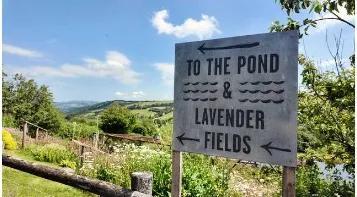
With farm stays growing in popularity, Cefnperfedd Uchaf farm has expanded to include a shop and café. A moving truck was transformed into a stylish stay, complete with a king-size bed. There’s also a Nordic sauna and hillside pond for swimming.
Belmond, the company that operates the Venice Simplon-Orient-Express, brings passengers to Cefnperfedd Uchaf as part of its three-day Britannic Explorer sleeper train journey through Wales. Guests can wander in the lavender fields, stop in the café and even take a dip in the pond on a hot day.
Durham spends most of her time at the farm. There are occasional trips to London. She has a May holiday planned with some friends. Cefnperfedd Uchaf is where she finds joy and plenty of laughter with her neighbouring farmers.
“The town and farm, they’re the family. They are so wonderful,” she said.
In an unsettling time of geopolitical conflict, being a Canadian in Wales carries some cred, especially after Prime Minister Mark Carney’s speech at the World Economic Forum Annual Meeting in Davos in January.
“I had people coming up to me and saying, ‘Oh, it must be wonderful to be Canadian.’ And I’d have to stop and think, what are they talking about? But of course, it was his speech, it had such a magnificent impact around the world.”